


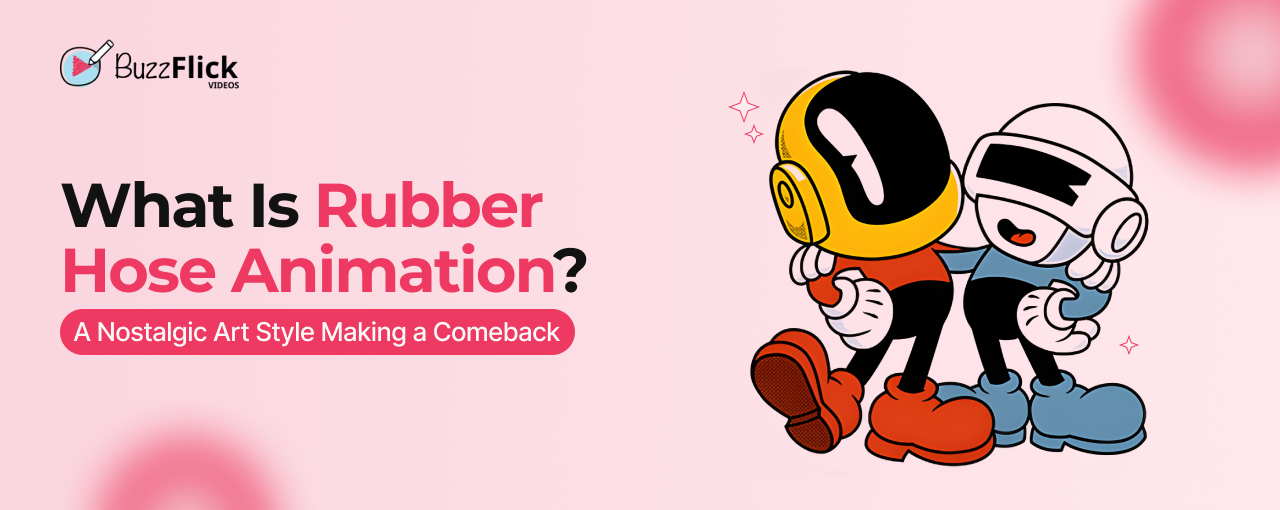
You know those super old cartoons? The ones where characters have arms and legs that bend and stretch like they’re made of rubber? That’s not just how they used to draw back then; it’s actually a special art style with a name.
It’s called Rubber Hose Animation.
This style, which people call the garden hose, was the core of the golden age of animation due to its use of limbs that were bent and jointless. It gave us Mickey Mouse’s cheerful bounce and the chaotic energy of Felix the Cat. However, with the development of cartoons, this style was gradually left behind as a fond memory.
Rubber hose animation is back in style! It’s fun, stretchy look shows up in popular games like Cuphead and online artwork. But what makes this vintage style so irresistible today?
Let’s take a closer look at rubberhose animation and find out why we’re falling in love with this old-school cartoon style all over again. So, let’s get started!
Rubber hose animation is an old cartoon technique of the 1920s and 1930s, in which the drawing of characters is made of elastic rubber tubes, with no joints, such as elbows or knees.
The early cartoon characters were marked by their cartoonish, wavy movement. Everything, people and animals, things of everyday life, was happy and wobbly on the move. It was not being realistic, but being fun and alive.
This style is what gives those old black-and-white cartoons their unique, timeless charm.
So, where did this wobbly style actually come from? It began right in the early days of cartoons, around the 1920s.
At the time, animation was a new world. It was extremely difficult and very time-consuming to draw characters with realistic bone and joint structure. Animators had to find a faster and easier way of moving their characters.
This idea was as simple as the solution: they simply did not draw elbows and knees. Their characters had arms and legs that were shaped like bendy rubber tubes or garden hoses. This was a gigantic time-saving process and gave these old-time cartoons their trademark soft, flowing texture.
These were some of the main characters and individuals who contributed to the success of this style:
Then, how could it be so popular, and then, why did it vanish?
Simply like, cartoons evolve with time. In the 1930s, Studios like Disney wanted to tell more complex stories with characters who displayed more natural emotions.
The playful, easy-going wiggle of the rubber hose was gradually being phased out by smoother, more refined animation.
The style that brought about the beginning of animation was shelved, and it now takes the lovable, nostalgic appearance that we know of today.
The rubber hose style has a couple of tricks that make it feel special. When you have an idea of what to look at, you can notice it immediately.
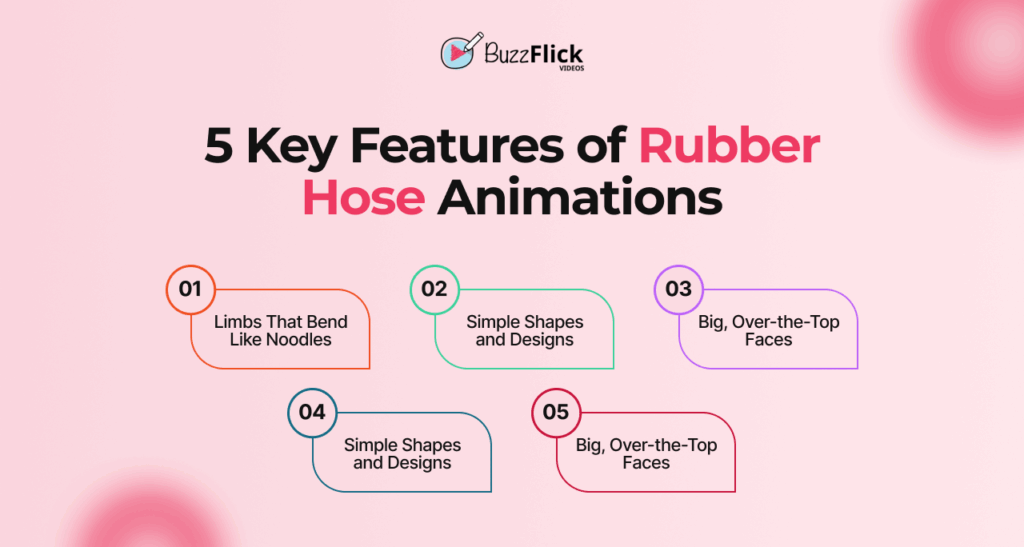
This is the biggest giveaway. Characters do not possess knees and elbows. Their limbs are so soft and stretchy like rubber tubes, which can bend up and continue to twist or stretch to unbelievable lengths. It was not realistic, but funny and expressive.
Simple circles and ovals were used as the characters. This simplified them to be traced and redrawn many times, and this was essential in hand-drawn animation. This minimalism is a large share of their very cute, classic appearance.
As the bodies were so plain, the faces did all the speaking. Massive, exaggerated character expressions were present, such as dramatic scowls, tremendous grins, or big, open-eyed amazement. You were never left wondering how they felt.
All was done in a playful, musical motion. Characters used to appear walking like they were dancing, and their moves were well synchronized with the music. This made the cartoons lively and happy.
Ever notice how a lot of old cartoon characters have their white gloves? The trick in making their hands visible on their dark bodies was easy, and the audience could easily identify what they were holding or doing.
And those eyes, a lot of characters possessed eyes that were merely large black dots with perhaps a small wedge cut out, so they appeared like a pie. An easy method of expressing direction and emotion was these pie-eyes.
First of all, we need to get straight one big misconception out of the way: “Rubber hose” does not imply that they used actual hoses to draw. It was named after the style of the limbs of the characters that were depicted as having been filled with bendy rubber tubing.
In the 1920s and 30s, the process of creating a rubber hose cartoon, which would be all-hand-drawn, was long and difficult. It occurred in the following way.
The Classic Hand-Drawn Process:
It all began with a mere story. Animators draw the key beats of the story in tiny, disjointed sketches known as a storyboard. They draw a model sheet of every character. This sheet depicted the character on all sides, thus all the artists similarly sketch them: with their round bodies, their pie-cut eyes, and white gloves.
This proved to be the most hectic part. A lead animator, also referred to as a key animator, draws the most significant poses of a motion, such as the beginning and the end of a leap.
Subsequently, the frames between these poses were to be drawn by junior animators known as in-betweeners to make the movement smooth. To produce one second of motion picture, they had to sketch 12 to 24 separate images.
The pencil drawings, when perfect, were sent to the inking department. Here, the pencil lines were carefully drawn on a fresh, clear piece of plastic known as a cel. Once the inking was complete, the colors on the back of the cel were filled in by the painting department to maintain the lines being crisp. That is why the backgrounds were so simple and cartoonish; it saved so much work.
At last, the painted cels were overlaid upon one hand-painted background. One by one, they would be photographed by a special camera. When one photo was finished, the crew replaced the cel with the new one in the line. All these photos were projected at the same time, and the magic was done: the characters came alive.
It might seem strange to use modern 3D animation tools for a 100-year-old style, but it’s a fantastic way to create something unique. Here’s a simple breakdown of how today’s artists do it.
The first step is to build a special digital skeleton, known as a “rig.” For this style, the rig isn’t made to be realistic. Instead, animators use controls that let limbs stretch to impossible lengths and bodies squash flat without breaking. This “bendy bone” setup is the foundation for all the classic rubber hose movement.
The challenge is making 3D models look like old-school cartoons instead of being realistic. Artists do this by using toon shaders or cel shaders tools that create flat colors and bold outlines instead of fancy, realistic shadows.
The most important touch is adding a thick, black outline around the character, which instantly makes it feel like a drawing from the 1920s.
Here is where the style really comes alive. The animators adhere to the traditional rules of exaggeration. All the movements are larger; a jump is a gigantic wind-up, the character is stretched in the air, and then collapses. The movements do not simply end, but they wobble or jiggle a bit at the end, to keep things in motion and entertaining.
You do not need to create everything on your own. Software such as the RubberHose extension to After Effects has been developed to make such fluid, jointless arms and legs rapidly. In 3D animation software like Blender, powerful rigging systems help set up these flexible characters faster, letting artists focus on the fun part: the animation itself.
The old, wobbly cartoon style from the 1920s is popular again. You can see its fun, bouncy look in many modern places.
Game makers use this style to make their games look unique and full of energy.
Streaming services and movie studios use this style to make us feel happy and nostalgic.
Companies use this style in their ads to seem fun and friendly.
The rubber hose style isn’t just a blast from the past; it’s a creative tool with a bright and exciting future. As technology and storytelling evolve, this classic look is finding new and surprising roles.
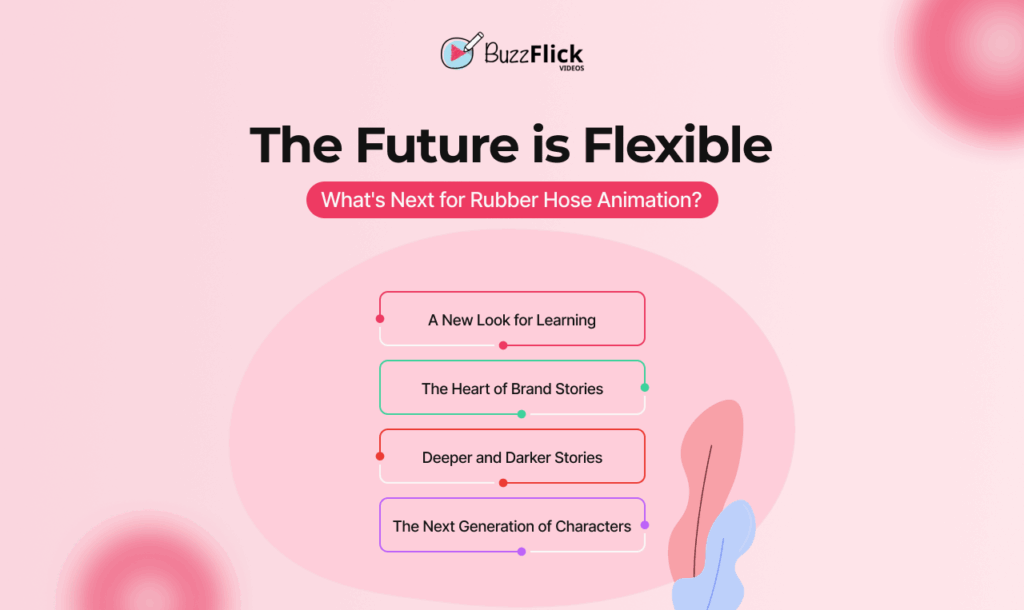
Here’s a look at where this wobbly, wonderful style is headed next.
Imagine a science video where complex ideas bounce and stretch to explain themselves. The simple, clear shapes of rubber hose animation are perfect for educational content. It might help in making learning more fun and less of a lecture, particularly among children.
Companies require an individual character to be distinctive. Rubber hose animation provides a more human touch of handmade that large, polished 3D advertisements are missing. This style will be used by more brands to produce likable mascots and commercials that are nostalgic and full of charm.
What makes us laugh can be used to give you a shiver as well. Artists are finding it ideal in psychological thrillers and horror with its surreal and physics-defying movements. Placing the dark situation with a rubbery and cheerful character is a strong and disturbing contrast.
The future of this style is not merely the making of the old look. It is a matter of combining the new with the old. There will be AI-assisted animation tools that will allow artists to create these bendy characters quickly. We will also watch them in a virtual reality (VR) and interactive digital mascots, where their inexhaustible energy will be exported into complete immersion worlds.
If you’re looking to bring that classic, bouncy cartoon style to life, BuzzFlick, a leading animation studio in Houston, is the team to call. We have an established track record of producing any type of animation, 2D and 3D, as well as motion graphics and explanatory videos.
Our experienced animators understand how to create a combination of the old magic and establishments of rubber hose animation with the new design and technology, so that your project will have a different and dynamic touch. Whether it’s for a video game, short film, or brand animation, we make sure every frame is full of creativity and fun.
Rubber hose animation is an older form of cartoon, of the 1920s and 1930s. It depicts characters with long and elastic bodies that move easily like rubber hoses. The legs and arms do not possess joints, and hence they bend and twist in whimsical and crazy fashions that sound playful and silly.
Yes, it’s still very popular! In the modern world, rubber hose animation is used by the creators to give their work a vintage and adorable feel. You can see it in modern TV programs, video games, and internet videos. Its popularity is that it gives people the nostalgic experience of the old days of cartoons, which are fun.
Yes, you can! It started as a 2D style, but modern technology has changed that. Today’s artists can take those same wiggly, bouncy movements and create them in 3D. It looks cool and lets animators do things they couldn’t do before while keeping that vintage feel.
It really depends on what you’re making. A short video clip might take just a few days to finish. But if you’re making a full animated video with lots of scenes and details, it could take several weeks.
BuzzFlick has a team of skilled animators experienced in both traditional and modern styles. We know how to keep the vintage charm while using the latest tools for a polished, professional finish.

Pourquoi choisir 1xbet au Cameroun ?1xbet Cameroun télécharger gratuitement : comment installer l’application sur Android et iOSPrérequis techniquesProcédure de téléchargement directCréation de compte et vérification...
Read More
Get A Custom Quote Now


Copyright © Buzzflick 2026, All Rights Reserved.
Get Video Animation at Reasonable Prices at BuzzFlick! Get A Quote!